
Charge entry and claim filing are critical steps between clinical documentation and payer reimbursement. Charges must accurately reflect the services provided, while claims must contain the required patient, provider, diagnosis, procedure, and payer information before submission.
Healthcare Revenues provides charge entry and claim filing services for physicians, medical practices, specialty practices, clinics, hospitals, and healthcare organizations across the United States.
Our team supports the process from charge capture and charge entry through claim creation, review, electronic submission, and follow-up on rejected claims. We work with the coding and billing information provided by the practice to help ensure claims are prepared accurately and submitted according to applicable payer requirements.
Charge entry is the process of entering billable healthcare services into the practice management or billing system based on the provider’s documentation and applicable coding information.
Claim filing is the process of creating and submitting the resulting claim to the appropriate insurance payer for adjudication and payment.
These processes are connected but serve different purposes.
Charge Entry
Charge entry converts information about services provided into billing records. Depending on the practice workflow, this may involve:
Claim Filing
Once the required billing information is available, a claim is created and reviewed before being submitted to the appropriate payer.
A typical workflow is:
Clinical Documentation → Coding → Charge Capture → Charge Entry → Claim Creation → Claim Review → Claim Submission

A charge represents a service provided by a healthcare professional. If that service is entered incorrectly, incompletely, or too late, the issue may affect subsequent billing and reimbursement activities.
Common charge-entry problems include:
Service Provided → Documentation → Coding → Charge Entry
If a documented service is never captured as a charge, it may never reach the claim.
This can create revenue leakage because the practice provided a service but the corresponding charge was not properly entered into the billing workflow.
Accurate and timely charge entry helps ensure that billable services are represented correctly before claims are created.
Charge entry and claim filing involve several connected steps.
This workflow helps move a claim from the practice’s billing system into the payer’s adjudication process.
Healthcare Revenues provides charge entry support based on the practice’s specialty, systems, workflow, and billing requirements.
We review available documentation and coding information according to the established workflow to help identify services that should be represented in the billing system.

Charges are entered into the applicable practice management or billing system using the information provided by the practice and its established coding workflow.
Charge entry may include applicable CPT and HCPCS information associated with the documented services.

Diagnosis information is included in the claim workflow based on the coding information available for the encounter.

Applicable modifiers are reviewed as part of the established billing and claim-preparation process.

Relevant units, dates of service, provider information, place of service, and other required billing details are entered according to the applicable workflow.

Available billing information may be reviewed for potential duplicate charges before claims are submitted.
Potential inconsistencies or missing information identified during the charge-entry process are flagged for appropriate review.










A clean claim is generally a claim that contains the information required for the payer to process it without an avoidable administrative error or correction.
A claim may require information such as:
A claim may still be denied after passing initial claim edits. Claim scrubbing does not guarantee payment or eliminate all denials.
Payer adjudication may depend on additional factors, including coverage, medical necessity, authorization, provider participation, coding, documentation, contractual requirements, and payer policy.
A rejection generally occurs before the payer adjudicates the claim because the claim contains an error, missing information, or does not pass applicable submission or formatting requirements.
Examples may include:
Rejected claims are typically identified through the clearinghouse or electronic claim submission process. The rejection information can help determine what needs to be corrected before the claim can be successfully transmitted.
Rejected claims are reviewed, corrected, and resubmitted when appropriate to help prevent delays in the claims process.
A denial generally occurs after the payer processes or adjudicates the claim and determines that payment will not be made as submitted.
Denials may involve issues such as:
Rejected claims and denied claims therefore require different follow-up approaches.
Healthcare Revenues also provides Accounts Receivable Management and broader Revenue Cycle Management services to support downstream claim and payment issues.
Healthcare organizations may experience problems at this stage of the revenue cycle because of:
Speed matters, but accuracy must come first.
A delayed charge may delay the creation and submission of the associated claim. A claim submitted with incorrect or incomplete information may require additional work and create further delays.
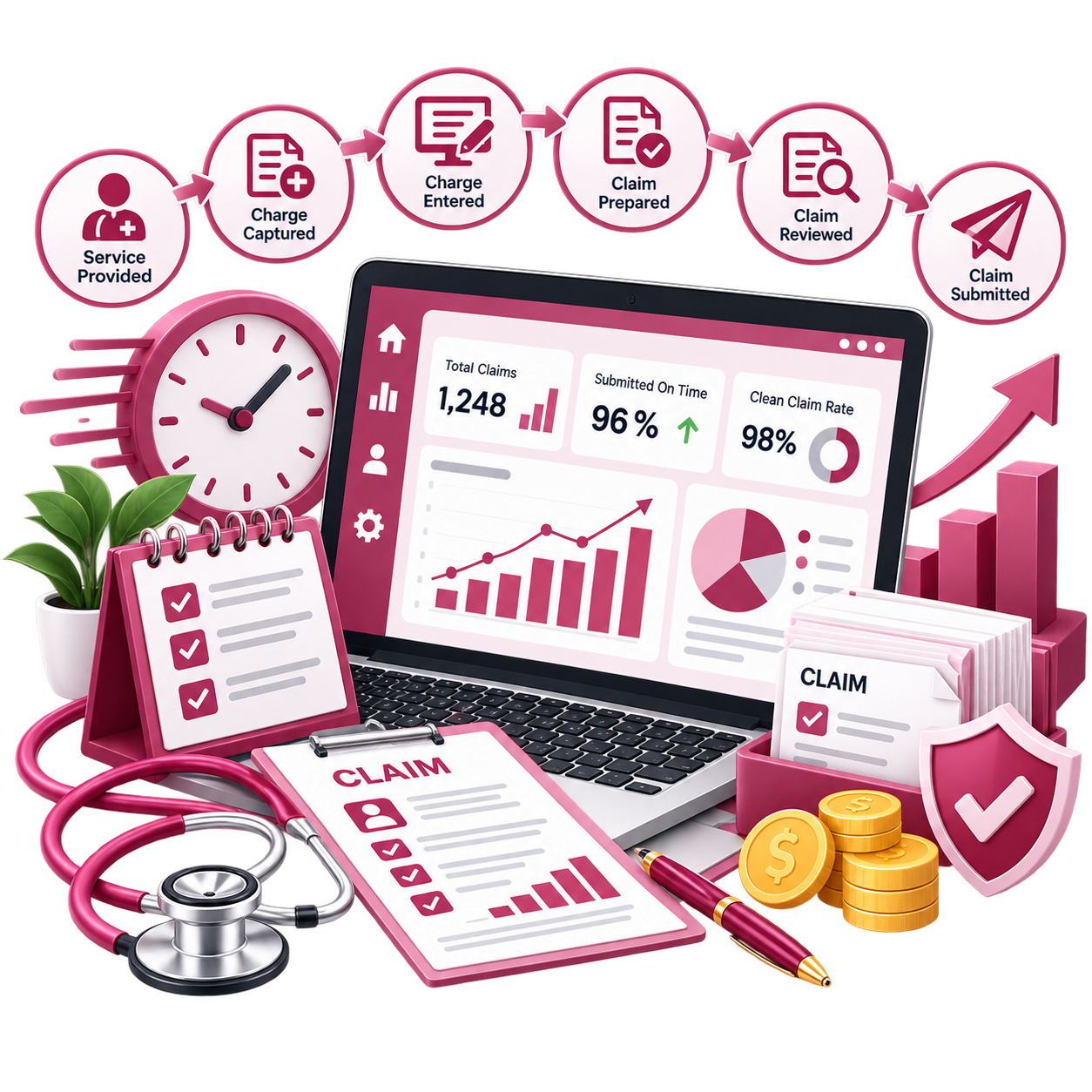
The desired workflow is:
Service Provided → Charge Captured → Charge Entered → Claim Prepared → Claim Reviewed → Claim Submitted
Timely processing helps move claims into payer adjudication sooner while accurate charge and claim information helps reduce avoidable administrative issues.
Payer-specific timely filing requirements also make it important for practices to monitor submission timelines
Charge entry and claim filing sit near the beginning of the billing portion of the revenue cycle.
A simplified revenue cycle looks like:
Patient Registration → Eligibility → Patient Encounter → Documentation → Coding → Charge Entry → Claim Filing → Payer Adjudication → Payment Posting → A/R → Denial Management
Problems at the charge-entry or claim-filing stage may affect several downstream activities.
For example:
Missing Charge
→ Service not billed
→ Potential revenue leakage
Incorrect Claim Information
→ Claim rejected
→ Correction required
Late Claim Submission
→ Timely filing risk
→ Potential reimbursement issue
Incomplete Claim
→ Additional payer or clearinghouse processing
→ Additional administrative work
This is why charge entry and claim filing should be treated as connected operational processes rather than isolated billing tasks.
Charge entry depends on information generated earlier in the healthcare workflow.
The relationship is:
Provider Documentation → Medical Coding → Charge Entry → Claim Filing
Clinical documentation establishes what occurred during the patient encounter. Coding translates the documented services and diagnoses into standardized coding information. Charge entry uses the available billing information to record the services, and claim filing moves the resulting claim toward payer adjudication.
Healthcare Revenues also provides Medical Coding Services to support the coding stage of the revenue cycle.
The objective is not to change clinical documentation or coding independently. Charge entry and claim filing should follow the documentation, coding, payer, and billing requirements applicable to the encounter.

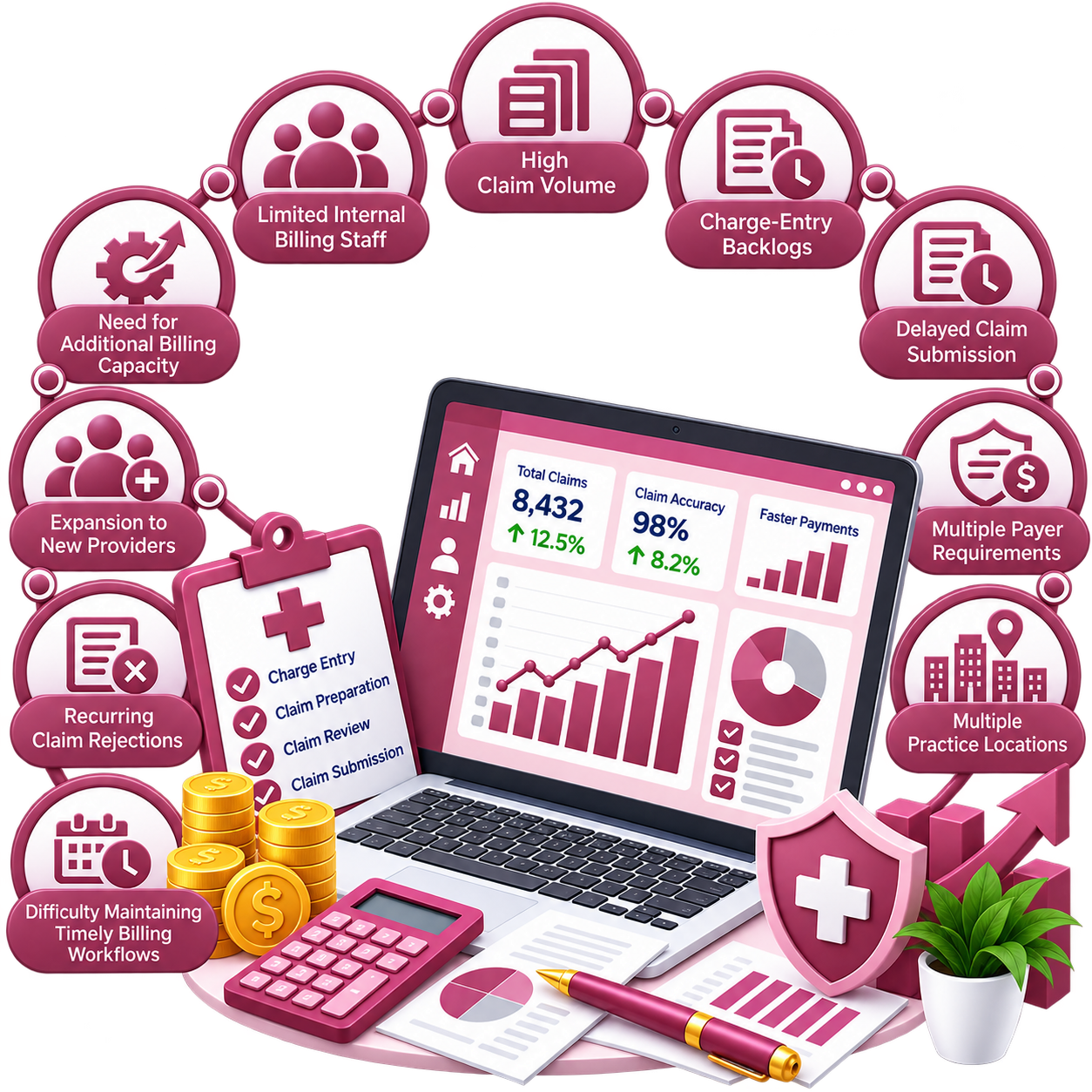
Healthcare organizations may outsource charge entry and claim filing when they need additional billing capacity, more consistent processing, or support managing claim volume.
Common reasons include:
Outsourcing does not eliminate the practice’s responsibility for accurate clinical documentation, coding oversight, payer contracts, or other provider obligations. Instead, it provides additional operational support within the established revenue cycle.
Healthcare Revenues provides Charge Entry & Claim Filing Services for:
Our charge entry and claim filing services support different specialties, payer mixes, practice sizes, and billing environments.

Healthcare Revenues brings approximately 15 years of healthcare industry experience to its work with U.S. healthcare organizations.
Our approach is results-oriented. We focus on the work that needs to be completed, communicate clearly throughout the process, and deliver what we commit to providing.
Charge entry and claim filing are also connected to coding, medical billing, payment posting, A/R, and the broader revenue cycle. Our broader service portfolio allows these functions to be addressed as connected parts of the healthcare billing workflow.

HEDIS consulting provides professional support for healthcare organizations that need help with HEDIS measures, data collection, medical record review, care gap identification, patient outreach, reporting, and quality improvement.
HEDIS stands for Healthcare Effectiveness Data and Information Set.
HEDIS measures are standardized healthcare performance measures used to evaluate different aspects of healthcare quality and effectiveness.
HEDIS measures are widely used across healthcare quality programs, particularly by health plans and organizations involved in quality measurement and performance improvement.
HEDIS covers numerous areas of healthcare quality, which can include preventive care, chronic disease management, behavioral health, medication management, women’s health, children’s health, and other quality areas.
A HEDIS care gap represents an opportunity where an eligible patient may not have received a required or recommended service associated with an applicable quality measure.
For example, a patient may be identified as needing a preventive screening or follow-up service.
Care gap closure can involve patient identification, outreach, appointment scheduling, care coordination, provider intervention, documentation, and follow-up.
The specific approach depends on the applicable measure and patient population.
HEDIS medical record review involves examining patient records for clinical information and documentation relevant to applicable quality measures.
Medical record review can help identify evidence of care that may not be available through other data sources.
Professional consulting cannot guarantee a specific HEDIS score. However, structured quality management, accurate data collection, effective care gap identification, patient outreach, and performance improvement processes can help organizations address opportunities that affect applicable measures.
No. HEDIS and MIPS are different quality measurement frameworks.
HEDIS consists of standardized healthcare performance measures, while MIPS is a CMS program under the Quality Payment Program that evaluates eligible clinicians using applicable performance requirements.
Some clinical and operational activities can support performance across both frameworks.
No. HEDIS and PCMH serve different purposes.
HEDIS focuses on standardized healthcare quality measures, while PCMH is a care delivery and practice transformation model centered on patient-centered, coordinated care.
However, certain quality improvement and care coordination activities can support both.
Accurate charge entry and timely claim submission help move services from the patient encounter into the payer reimbursement process.
Healthcare Revenues provides charge entry, claim preparation, electronic claim submission, rejection identification, correction, and resubmission support for U.S. healthcare organizations.