Old accounts receivable can represent revenue that has remained unresolved for months or longer. Aging claims may involve unpaid insurance balances, denied claims, incomplete follow-up, payment issues, missing information, or other unresolved account problems.
Healthcare Revenues provides old A/R cleanup services for physicians, medical practices, specialty practices, clinics, hospitals, and healthcare organizations across the United States.
Our team reviews older outstanding accounts, researches claim and payment history, identifies the reason an account remains unresolved, and determines the appropriate next step based on the available information.
Whether you have inherited old A/R from a previous billing company, experienced a billing transition, accumulated aging claims, or simply have a backlog of unresolved accounts, Healthcare Revenues will provide focused support to work through the outstanding balances.

Old A/R cleanup is a focused process for reviewing and working outstanding healthcare accounts that have remained unpaid or unresolved for an extended period.
Unlike ongoing A/R management, which involves continuous monitoring and follow-up, old A/R cleanup focuses specifically on aged and unresolved accounts that have accumulated over time.
These accounts may include:
A/R does not always resolve simply because a claim was submitted.
An account may remain outstanding because of:
When these accounts are not addressed consistently, they continue aging and become part of an organization’s older A/R.
The longer an account remains unresolved, the more research may be required to understand its current status and available options.
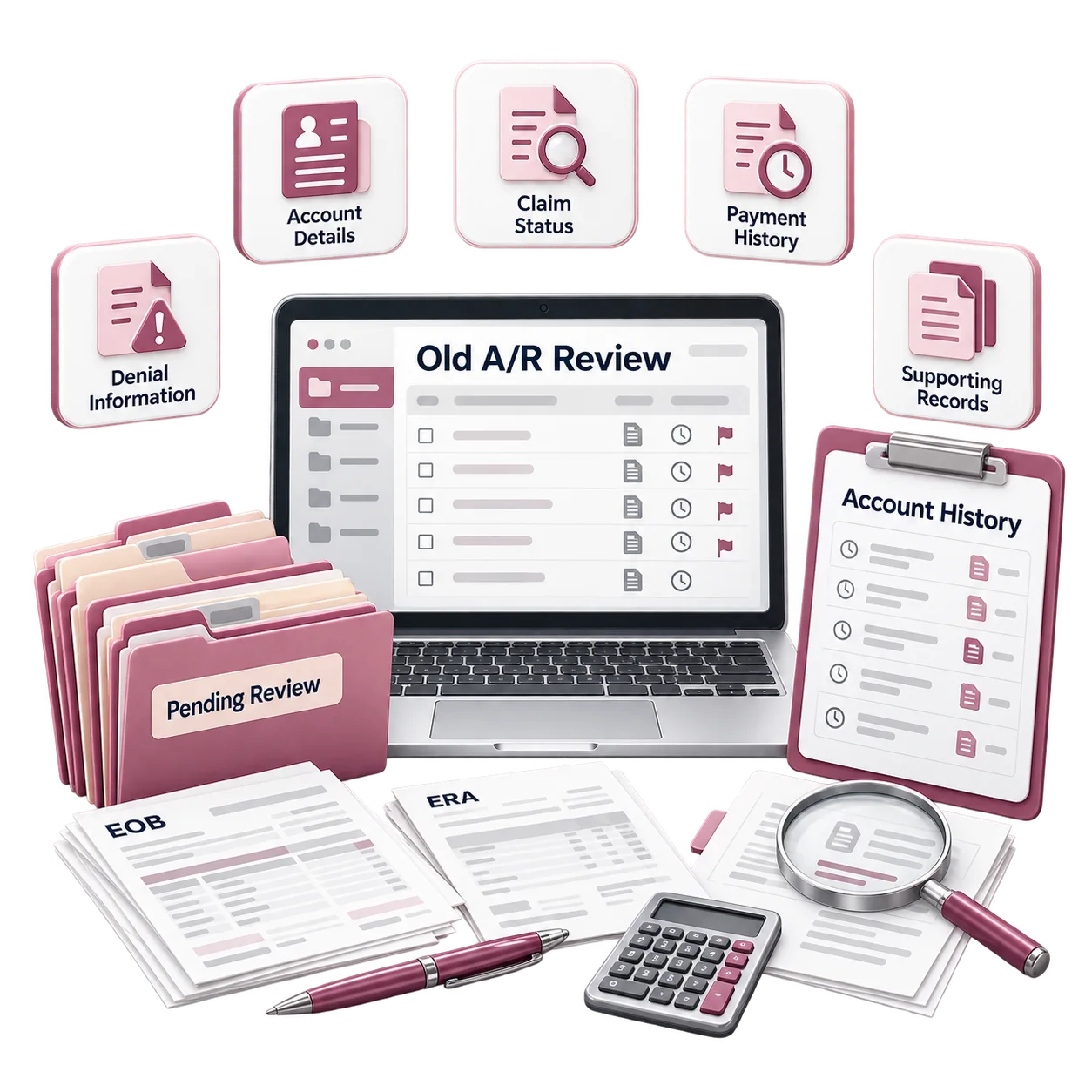
Our old A/R review may include:
The specific review depends on the age, type, payer, history, and available information for each account.

We review the available A/R information to understand the size, age, payer mix, and general condition of the outstanding accounts.

Accounts are organized based on age and other relevant criteria to determine where focused review should begin.
We review available claim, payment, denial, adjustment, and follow-up information to understand the history of each account.
The account is reviewed to determine why it remains unresolved. Possible issues may include denial, rejection, pending status, payment discrepancy, missing information, or other billing-related problems.

Depending on the account, the next action may include payer follow-up, correction, resubmission, reconsideration, appeal, documentation review, or continued monitoring.

Where appropriate, we follow up with the payer or other relevant party and document the outcome.

Resolved accounts are documented, and remaining balances are reviewed for the next appropriate action.

An old claim should not automatically be treated as unrecoverable.
Each account needs to be reviewed based on its specific circumstances.
For example:
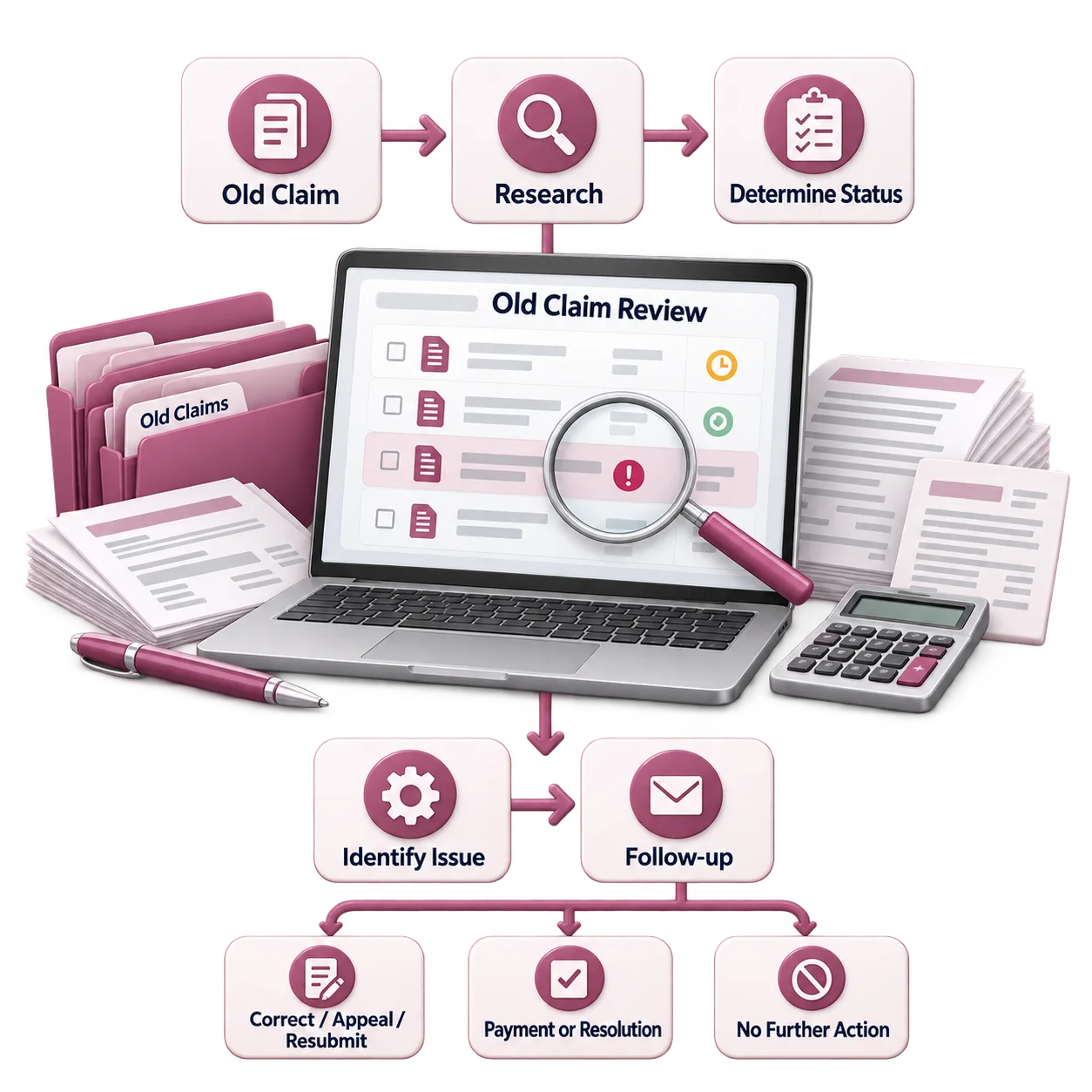
Old Claim → Research → Determine Status → Identify Issue → Follow-Up → Correct/Appeal/Resubmit → Payment or Resolution
Some accounts may still have a viable path toward payment. Others may require additional documentation, correction, appeal, or payer follow-up.
Some accounts may ultimately have no further appropriate recovery action available.
The purpose of old A/R cleanup is to review the accounts, determine what happened, and take the appropriate action based on the available information.

Timely filing requirements are an important consideration when reviewing older claims.
Payers may establish specific time limits for initial claim submission, corrected claims, reconsiderations, and appeals. These requirements vary by payer, contract, claim type, and circumstances.
During old A/R cleanup, available claim history and payer information should therefore be reviewed before determining the appropriate next step.
An old account does not automatically mean a claim is unrecoverable, but recovery options may be limited when applicable filing or appeal deadlines have passed.
Supporting records, such as submission confirmations, payer correspondence, and prior appeal documentation, can help clarify what actions have already been taken. Keeping these records organized supports account review and helps teams determine whether further follow-up is appropriate.
Ongoing A/R Management
Focuses on continuously monitoring and working outstanding accounts as part of the organization’s regular revenue cycle.
Old A/R Cleanup
Focuses specifically on older outstanding balances that have accumulated over time and require a dedicated cleanup effort.
A healthcare organization may use both services:
Old A/R Cleanup → Reduce Existing Backlog → Ongoing A/R Management → Prevent Future A/R Accumulation
This distinction keeps the old A/R service focused while connecting it naturally with the broader RCM process.
Healthcare organizations may accumulate old A/R after:
In these situations, a focused A/R cleanup project may help the organization understand and work through its existing backlog.
Signs that your organization may need an old A/R cleanup include:
A detailed A/R assessment provides a better understanding of the condition of the outstanding balances before cleanup begins.
The assessment can also help separate accounts needing immediate attention from those requiring further research or documentation. Establishing clear priorities and assigning follow-up responsibilities gives your team a practical starting point for addressing the backlog.
Healthcare Revenues provides old A/R cleanup services for:
The cleanup scope depends on the organization’s A/R volume, account age, payer mix, available records, and specific requirements.

Healthcare Revenues brings approximately 15 years of healthcare industry experience to the organizations we serve.
Our approach is results-oriented. We focus on the services we commit to providing, communicate clearly about the work being performed, and avoid unrealistic promises.
Old A/R requires more than simply contacting a payer. Each account may have a different history, issue, payer requirement, and available resolution path.
Healthcare Revenues approaches old A/R as part of the broader revenue cycle, connecting claims, billing, payment posting, denials, A/R, and reporting.

HEDIS consulting provides professional support for healthcare organizations that need help with HEDIS measures, data collection, medical record review, care gap identification, patient outreach, reporting, and quality improvement.
HEDIS stands for Healthcare Effectiveness Data and Information Set.
HEDIS measures are standardized healthcare performance measures used to evaluate different aspects of healthcare quality and effectiveness.
HEDIS measures are widely used across healthcare quality programs, particularly by health plans and organizations involved in quality measurement and performance improvement.
HEDIS covers numerous areas of healthcare quality, which can include preventive care, chronic disease management, behavioral health, medication management, women’s health, children’s health, and other quality areas.
A HEDIS care gap represents an opportunity where an eligible patient may not have received a required or recommended service associated with an applicable quality measure.
For example, a patient may be identified as needing a preventive screening or follow-up service.
Care gap closure can involve patient identification, outreach, appointment scheduling, care coordination, provider intervention, documentation, and follow-up.
The specific approach depends on the applicable measure and patient population.
HEDIS medical record review involves examining patient records for clinical information and documentation relevant to applicable quality measures.
Medical record review can help identify evidence of care that may not be available through other data sources.
Aging accounts should not remain unresolved simply because they have been outstanding for a long time.
Healthcare Revenues provides focused old A/R cleanup services to review aging balances, research unresolved claims, follow up on appropriate recovery opportunities, and help your organization understand what remains actionable.