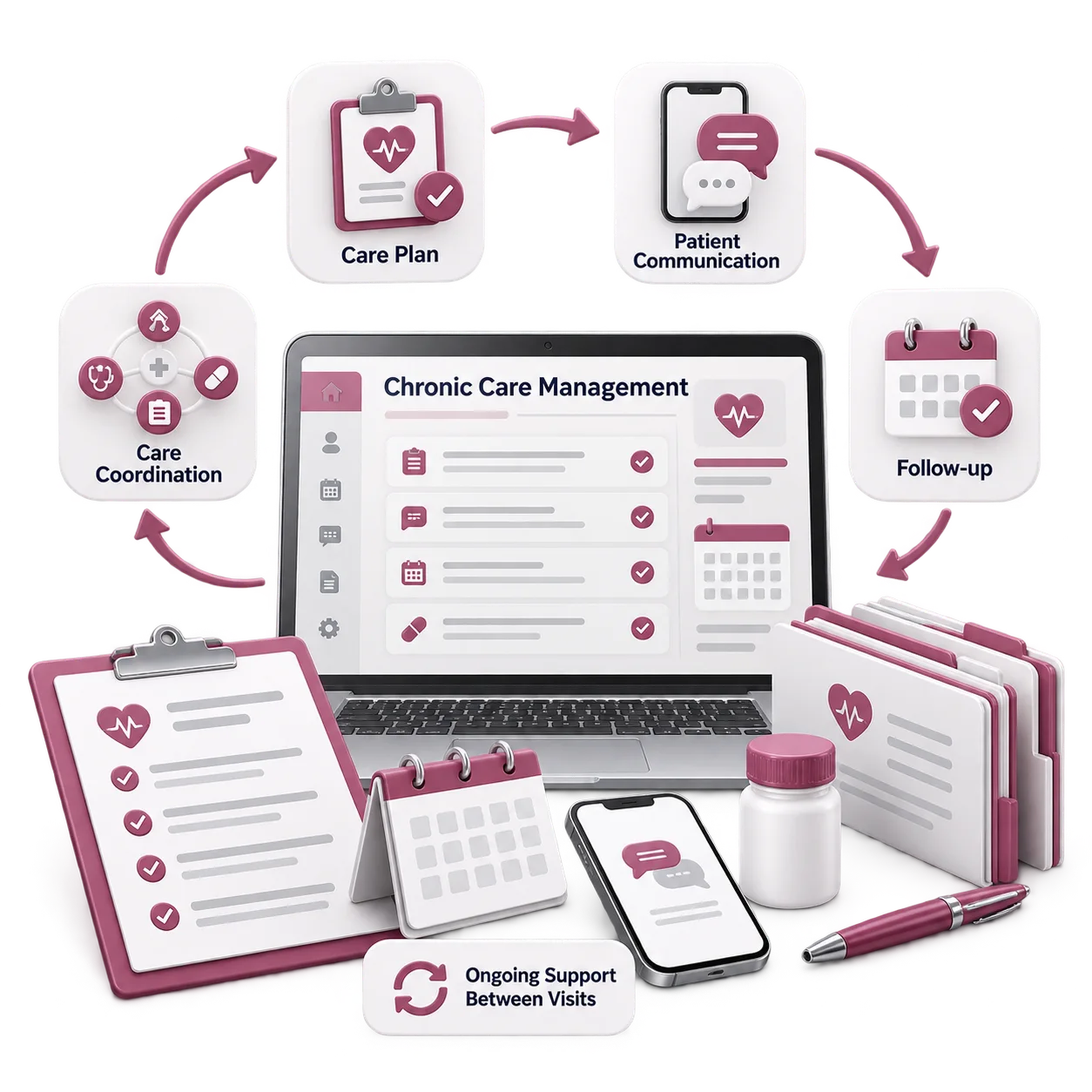
Chronic Care Management (CCM) is a structured approach to coordinating and managing care for patients with multiple chronic conditions that require ongoing attention.
Healthcare Revenues provides Chronic Care Management support for U.S. physicians, medical practices, specialty practices, and healthcare organizations. Our CCM services support care coordination, patient communication, care plan activities, documentation, follow-up, and other operational requirements associated with an ongoing chronic care management program.
For Medicare patients, CMS covers CCM for eligible patients with 2 or more chronic conditions expected to last at least 12 months or until death and that place the patient at significant risk of death, acute exacerbation or decompensation, or functional decline.
Healthcare Revenues will work within your organization’s established workflows and the applicable CCM requirements to support ongoing care management activities.
Chronic Care Management is a set of services designed to help coordinate and manage care for patients with chronic conditions that require ongoing attention.
CCM goes beyond an individual office visit. It involves continued management, communication, coordination, and monitoring between visits.
Depending on the patient’s needs and applicable requirements, CCM activities may involve:
For Medicare CCM, CMS states that eligible patients generally have two or more chronic conditions that:
Examples of chronic conditions listed by CMS include:
A typical CCM workflow may include:
Patient Identification → Eligibility Review → Patient Consent → Care Plan → Patient Outreach → Care Coordination → Ongoing Follow-Up → Documentation → Monthly Review → Billing
Each step must be handled according to the applicable program and payer requirements.
For Medicare CCM, CMS requires patient consent before CCM services begin, and the consent may be written or verbal as long as it is documented in the medical record. Patients may also discontinue CCM services.

Patient consent is an important part of Medicare CCM.
CMS states that patients must provide consent to receive CCM services, and consent may be obtained verbally or in writing and documented in the medical record. Patients should also be informed that cost-sharing may apply.
Healthcare organizations should establish appropriate procedures for:
Healthcare Revenues will work within the organization’s established CCM process and applicable requirements.
A care plan provides a structured basis for managing the patient’s chronic conditions.
CMS indicates that a comprehensive care plan may include elements such as:
The specific care plan should reflect the patient’s clinical needs and the requirements applicable to the service.

Patients with multiple chronic conditions may interact with multiple healthcare providers, pharmacies, specialists, and other healthcare resources.
CCM helps establish an ongoing process for communication and coordination.
Depending on the patient’s needs, care coordination may involve:
Primary Care Provider → Specialists → Pharmacy → Testing Facilities → Other Healthcare Providers → Patient/Caregiver
CMS describes CCM as including coordination of care between providers and other healthcare resources such as pharmacies, specialists, testing centers, and hospitals.
Clear communication also gives patients and caregivers an opportunity to share concerns, ask questions, and update the care team about changes in their needs. Documenting these conversations helps the team track follow-up tasks and keep relevant information available for ongoing coordination.
CCM billing is tied to specific service and time requirements.
For example, CMS currently lists:
The appropriate code depends on the service provided, practitioner, clinical staff involvement, time, patient circumstances, and applicable billing requirements.
Healthcare Revenues will support documentation and billing workflows based on the applicable requirements rather than treating every CCM patient or service the same way.
CCM involves both clinical care management and revenue cycle processes.
A simplified workflow is:
Patient Eligibility → Consent → Care Plan → CCM Activities → Documentation → Time Tracking → Claim Preparation → Claim Submission → Payment Posting → A/R
Proper documentation and billing processes are therefore important to the financial side of a CCM program.
Healthcare Revenues connects CCM operational support with relevant billing and revenue cycle processes.

Healthcare organizations may experience challenges such as:
A structured CCM workflow helps organizations maintain consistency across these activities.
Healthcare Revenues provides CCM support for:
CCM requirements and workflows may differ based on the organization, patient population, payer mix, staffing structure, and services provided.

Healthcare Revenues brings approximately 15 years of healthcare industry experience to the organizations we serve.
Our approach is results-oriented. We focus on the services we commit to providing, maintain clear communication, and avoid unrealistic promises.
CCM requires coordination between clinical workflows, patient communication, documentation, and billing. Our healthcare experience allows us to support these activities within the broader operational and revenue cycle environment.

Yes. Medicare covers CCM for eligible patients under the applicable requirements of the Physician Fee Schedule.
Healthcare Revenues provides Chronic Care Management services to support patient outreach, care coordination, care plan activities, documentation, and applicable CCM billing workflows.