Healthcare organizations need accurate information to understand revenue cycle performance, identify operational issues, monitor billing activity, and maintain appropriate compliance practices.
Healthcare Revenues provides reporting and compliance services for physicians, medical practices, specialty practices, clinics, hospitals, and healthcare organizations across the United States.
Our services support revenue cycle reporting, billing performance monitoring, A/R visibility, claims and denial reporting, payment analysis, operational reporting, and compliance-related oversight.
Whether you need better visibility into your billing operations, regular revenue cycle reports, or support reviewing compliance-related processes, Healthcare Revenues will work with your organization based on its reporting and operational requirements.
Healthcare reporting involves collecting, organizing, and reviewing operational and financial information to understand how a healthcare organization is performing.
Compliance involves following applicable laws, regulations, payer requirements, contractual obligations, internal policies, and established healthcare processes.
Together, reporting and compliance provide organizations with greater visibility into:
Accurate reporting helps organizations understand what is happening within their operations, while appropriate compliance processes help support consistent and responsible healthcare business practices.


Depending on your organization’s requirements, reporting may include:
The specific reports and metrics will depend on your organization’s services, systems, payer mix, and reporting requirements.
For example:
Claims → Denials → A/R → Follow-Up → Payments → Reporting
Reviewing these areas together provides a clearer picture of where revenue cycle issues are occurring.
Healthcare compliance involves more than simply following a checklist.
Healthcare organizations must operate within applicable requirements relating to areas such as:
Healthcare Revenues provides compliance-related support within the scope of the services we provide and the requirements applicable to your organization.
Important: Compliance requirements vary based on the organization’s services, structure, location, contracts, and applicable federal and state requirements. Our services do not replace legal advice from qualified healthcare counsel.

Compliance is also connected to everyday revenue cycle activities.
Revenue cycle compliance may involve reviewing processes related to:
Clear responsibilities, staff training, and regular process reviews can support these efforts. When issues are identified, documenting corrective actions and following up helps teams address gaps and improve consistency across revenue cycle operations.
Depending on the organization’s needs, reporting and compliance reviews may include:
The specific review areas will depend on the services being provided and the organization’s requirements.




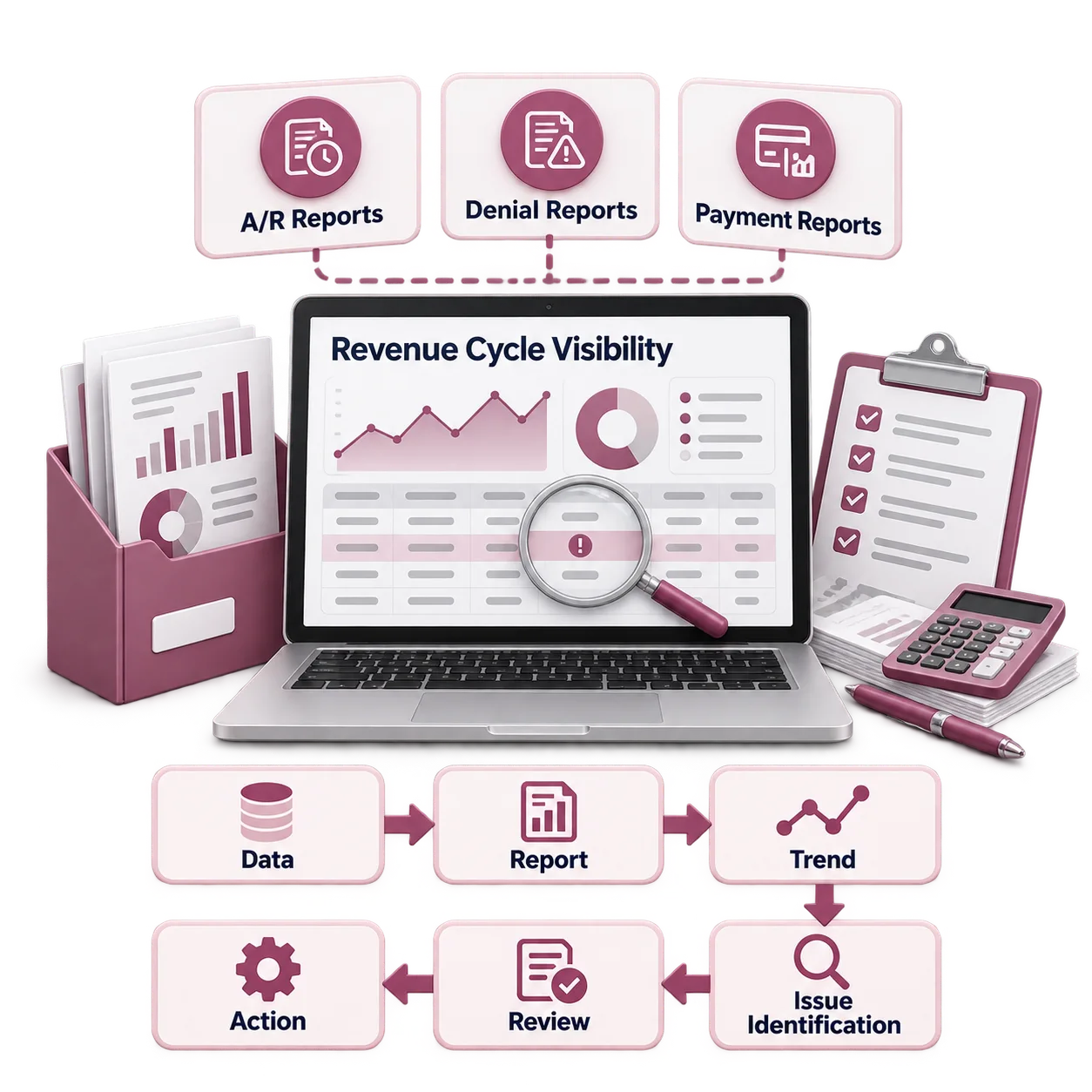
A report is useful when it helps an organization understand what is happening.
For example, an A/R report may show that outstanding balances are increasing. A denial report may identify repeated issues with a specific payer. A payment report may show changes in payment activity.
These reports provide information that helps organizations investigate the underlying issue.
Data → Report → Trend → Issue Identification → Review → Action
Healthcare Revenues uses reporting as part of broader revenue cycle oversight rather than treating reports as standalone documents.
Healthcare organizations may face challenges such as:
A structured reporting process helps organizations organize important information and identify areas requiring attention.

Healthcare Revenues provides reporting and compliance support for:
Reporting requirements vary significantly between organizations, so the scope of reporting will depend on the organization’s operational structure and needs.

Healthcare Revenues brings approximately 15 years of healthcare industry experience to the organizations we serve.
Our approach is results-oriented. We focus on the services we commit to providing, maintain clear communication, and avoid unrealistic promises.
Our understanding of billing, RCM, claims, A/R, payments, and healthcare operations allows reporting to be viewed within the broader revenue cycle rather than as isolated data.

HEDIS consulting provides professional support for healthcare organizations that need help with HEDIS measures, data collection, medical record review, care gap identification, patient outreach, reporting, and quality improvement.
HEDIS stands for Healthcare Effectiveness Data and Information Set.
HEDIS measures are standardized healthcare performance measures used to evaluate different aspects of healthcare quality and effectiveness.
HEDIS measures are widely used across healthcare quality programs, particularly by health plans and organizations involved in quality measurement and performance improvement.
HEDIS covers numerous areas of healthcare quality, which can include preventive care, chronic disease management, behavioral health, medication management, women’s health, children’s health, and other quality areas.
A HEDIS care gap represents an opportunity where an eligible patient may not have received a required or recommended service associated with an applicable quality measure.
For example, a patient may be identified as needing a preventive screening or follow-up service.
Care gap closure can involve patient identification, outreach, appointment scheduling, care coordination, provider intervention, documentation, and follow-up.
The specific approach depends on the applicable measure and patient population.
HEDIS medical record review involves examining patient records for clinical information and documentation relevant to applicable quality measures.
Medical record review can help identify evidence of care that may not be available through other data sources.
Healthcare Revenues provides reporting and compliance support to help healthcare organizations understand their revenue cycle activity, monitor important performance areas, and maintain appropriate operational oversight.