
Dialysis billing involves facility-specific Medicare requirements, payer coordination, claim submission, payment posting, and follow-up on outstanding balances. When billing issues remain unresolved, your team needs a clear process for identifying the problem and deciding what to do next.
Healthcare Revenues LLC provides medical billing and revenue cycle management support for healthcare organizations. We will discuss your dialysis facility’s billing requirements, define the services included in your agreement, and establish responsibilities for the agreed billing work.
Dialysis billing involves more than submitting a claim and waiting for payment. Facility billing requirements, patient coverage, payer rules, documentation, and claim details must align.
Each issue needs to be reviewed against the relevant claim details and payer requirements. Healthcare Revenues LLC will manage the billing activities included in your agreement, track unresolved items within the agreed workflow, and communicate issues that require further attention.

Your facility needs billing information that reflects the services furnished, the applicable billing requirements, and the payer responsible for processing the claim. Our dialysis billing support will cover the activities agreed upon with your organization.
We will review available patient and payer information, including coverage and benefits relevant to the billing workflow.
Where applicable, the review will identify information needed to clarify coordination of benefits or other payer requirements.
We will handle charge entry and claim preparation within the agreed scope, checking the available billing information for discrepancies that require attention before submission.
Items that need clarification will be identified so they can be resolved before the claim moves forward.
We will submit claims through the agreed process and follow up on outstanding items within the defined workflow.
Claims requiring additional information, correction, or further payer review will be identified for the appropriate next action.
We will review denial and rejection information, examine the relevant claim details, and identify the appropriate next step.
Depending on the circumstances, this will involve claim correction, additional documentation, or an appeal when supported by the payer’s requirements.
We will record payments and adjustments against the relevant accounts within the agreed scope.
Where payment information does not match the expected account activity, we will identify the discrepancy for further review.
We will monitor outstanding accounts and follow up on unresolved claims according to the agreed process.
Your facility will have a defined approach to reviewing aging balances and identifying accounts that require additional action.
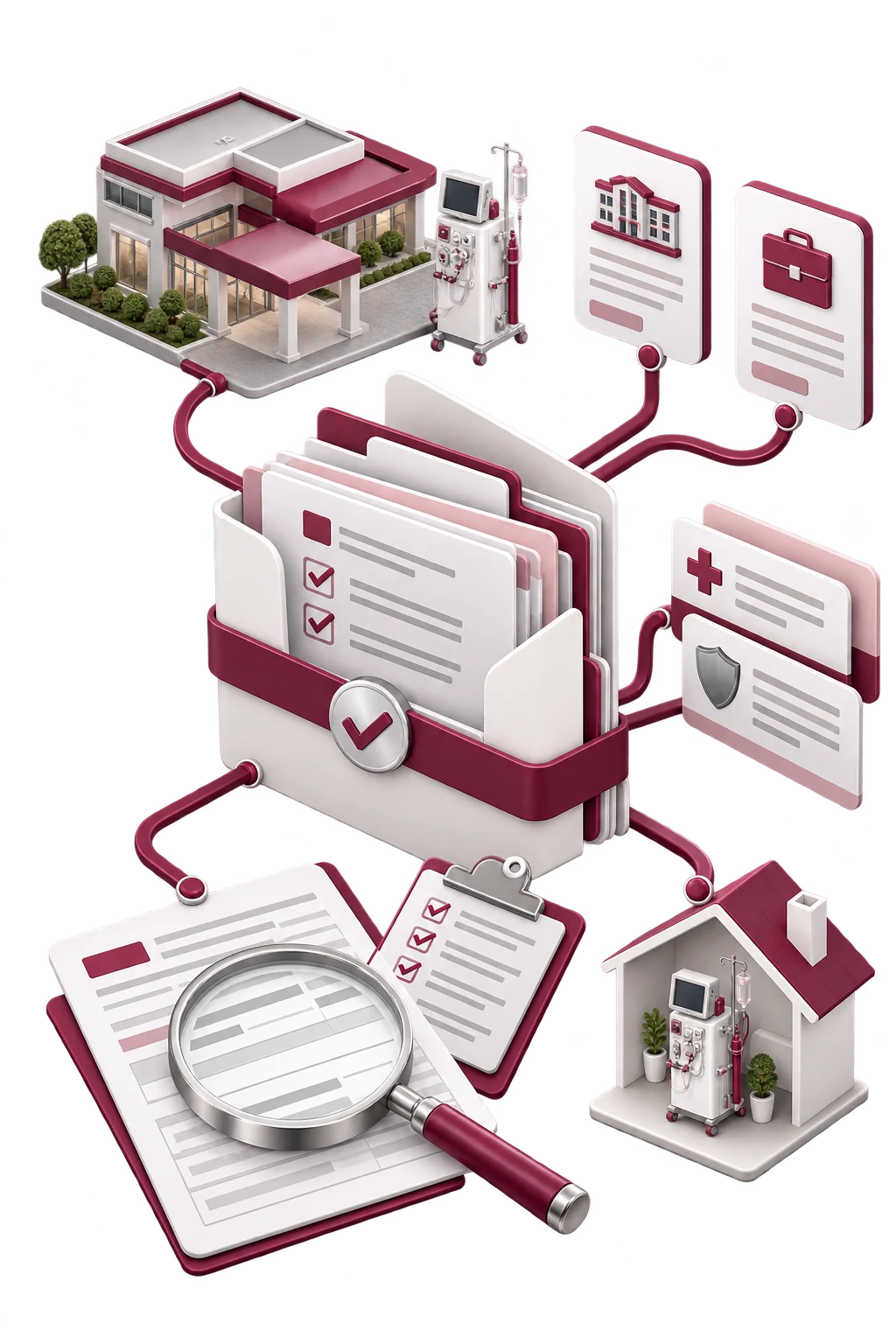
End-Stage Renal Disease (ESRD) billing follows Medicare requirements that differ from many standard professional medical billing workflows. For outpatient maintenance dialysis, Medicare’s ESRD Prospective Payment System (PPS) establishes a bundled payment framework for covered renal dialysis services. Consolidated billing rules also affect how certain related items and services are billed. Learn more from CMS.
An unpaid claim needs more than another status check. The reason for the delay or denial must be reviewed before the next action is determined.
Our agreed claims management process will focus on:
When similar issues recur, we will identify the pattern for review within the agreed reporting process, giving your team a clearer basis for prioritizing unresolved accounts.
No billing process guarantees that every claim will be accepted or paid. Each claim remains subject to the applicable coverage, documentation, filing, and payer requirements.

Payment posting and accounts receivable management help your facility understand what has been paid, what remains outstanding, and which accounts require further investigation.
Accurate payment records and consistent follow-up give facility administrators and billing teams a clearer view of unresolved account activity. The purpose is to make outstanding items easier to identify and manage, not to promise a particular collection rate or reimbursement outcome.
Revenue cycle management connects the activities that take place before a claim is submitted with the work required to resolve processing issues and record payments.
Our RCM support will cover the following activities when included in your service agreement:

Track unresolved items and available payer responses.
Identify the next action for claims requiring attention.
Record payments and identify discrepancies.
Communicate relevant billing activity and unresolved items according to the agreed reporting arrangement.
The scope of work will define which activities Healthcare Revenues LLC handles and which responsibilities remain with your facility.

Outsourced billing deserves consideration when your facility needs additional support with claim processing, payer follow-up, or outstanding accounts.
Before work begins, Healthcare Revenues LLC will review your requirements and define the agreed services, responsibilities, reporting expectations, communication procedures, and implementation needs.
Your facility will know which billing activities are included, how unresolved issues will be handled, and how billing information will be communicated.
Dialysis organizations need to distinguish between clinician-focused reporting requirements and quality programs that apply to dialysis facilities.
The Merit-based Incentive Payment System (MIPS) is part of the CMS Quality Payment Program. Eligibility depends on the clinician type, Medicare enrollment, service volume, and other applicable CMS criteria. Nephrology clinicians do not all have identical reporting obligations.
Healthcare Revenues LLC will discuss MIPS consulting and reporting support for eligible clinicians where the service is included in the agreed scope. Eligibility and reporting requirements will be checked against current CMS guidance for the relevant performance year.
The End-Stage Renal Disease Quality Incentive Program (ESRD QIP) is a separate CMS program for applicable dialysis facilities. It links facility payment to performance on specified quality measures, with payment reductions possible when performance standards are not met. Read the official CMS ESRD QIP overview.
ESRD QIP requirements are not interchangeable with MIPS requirements, and each program must be assessed independently.
ESRD QIP consulting and facility quality-reporting support are not included unless separately confirmed in your service agreement. Reporting support does not guarantee a particular MIPS score, compliance determination, or payment adjustment.
Before billing work begins, we will establish the scope of support and the responsibilities involved.
Our team will review your facility’s existing billing workflow, identify areas requiring assistance, and discuss the services that align with your operational needs. This approach helps clarify expectations, coordinate responsibilities, and establish a consistent process for managing billing activities.
Our process will focus on six areas:
Review how your facility handles claims, payments, denials, and outstanding balances.
Identify the billing tasks and unresolved accounts requiring attention.
Define the activities included in the agreement and the responsibilities that remain with your facility.
Establish how billing issues and account status will be shared.
Confirm system access, responsibilities, and relevant data-security arrangements before work begins.
Schedule regular reviews of billing activity, recurring issues, and outstanding accounts once services are underway.
This approach gives your facility a clear understanding of the work included in the agreement and the process for handling unresolved billing issues.
Dialysis billing services may include eligibility review, charge entry, claim preparation and submission, denial follow-up, payment posting, and accounts receivable management. Healthcare Revenues LLC will define the services included in your agreement before work begins.
Dialysis revenue cycle management covers the billing workflow from patient and payer information review through claim submission, payment posting, denial follow-up, and accounts receivable monitoring. It connects these activities so unresolved issues can be identified and assigned for follow-up.
ESRD billing involves specific Medicare payment and consolidated billing requirements for covered renal dialysis services. Facility billing also differs from professional billing where separate billing pathways apply. The correct approach depends on the service, setting, payer, and patient circumstances.
We will review the denial reason, relevant claim information, and applicable payer requirements to identify the next action. Corrected claims, additional documentation, or appeals will be handled when appropriate to the issue and included in the agreed scope.
Accounts receivable management helps a facility track outstanding claims, aging balances, and accounts requiring payer follow-up. It provides a clearer view of unresolved billing activity and the actions needed to investigate it.
MIPS applies to eligible clinicians under the CMS Quality Payment Program. ESRD QIP is a separate program focused on applicable dialysis facilities and their performance on specified quality measures. The two programs have different eligibility, reporting, and payment rules.
No. MIPS eligibility is determined for clinicians and applicable reporting arrangements under CMS criteria. ESRD QIP has separate requirements for applicable dialysis facilities. Each program must be assessed independently.
The availability of home dialysis billing support must be confirmed against the company’s service scope. Before contracting, your facility should establish which home dialysis billing workflows, services, and payer requirements are included.
Contact Healthcare Revenues LLC to discuss your current billing workflow, outstanding claims, denial follow-up, payment posting, and accounts receivable needs. We will review your requirements and define the proposed scope of support.
Your facility needs a clear process for managing claims, investigating billing discrepancies, recording payments, and following up on outstanding balances.
Healthcare Revenues LLC will discuss your current workflow, identify the billing responsibilities that require support, and define the proposed scope of work.
Tell us about your dialysis facility and the billing support you need.